

If you've got a pip deck and it's confounding you, try this!
Don't rehome your cards, they're still speaking to you, I promise!

A lot of people don’t like pip decks. I get it; they’re hard to read, especially in a magickal community that was collectively socialized and imprinted with the RWS Tarot and the Golden Dawn teachings baked into it. When you come across a pip deck, particularly one that predates the RWS and comes from an entirely different Tarot tradition, it can feel very frustrating to read.
This is where a little knowledge of numerology and an imagination can come in handy. If you’ve ever looked at pip cards (the Minor Arcana aces, twos, threes, etc) and thought “Well, this is just a bunch of cups. How does it mean anything?” You are in the right place. I work with the TdM (Tarot de Marseille), and let me tell you, once you disrupt the mindset of “picture on card must always equal X,” your world opens up, and it is much easier to do with pips than with pictorial scenes. I look at picture decks the same way I look at movies and pip decks the way I regard books.
Let’s review some basic numerology:
Ace/One: initiates, has the idea
Two: grows and nurtures, protects
Three: bursts into reality and grows
Four: the first attempt at stability and control, tries to preserve
Five: the challenge, disruption, or growth spurt of a thing
Six: balance, stability, and control (Four may be the square, but Six is the cube!)
Seven: Disruption and crisis points, options, and reconsidering direction
Eight: Taking stock, perfecting, making final edits
Nine: The wrap-up, that last struggle/burst of energy as we complete and move towards a new cycle
Ten: Basically a one with a purse or some extra baggage (that pesky zero!). New beginnings are happening whether you put the purse down or not.
Now let’s have a look at the pips from each suit. This won’t be comprehensive, but it should give you a place to start:
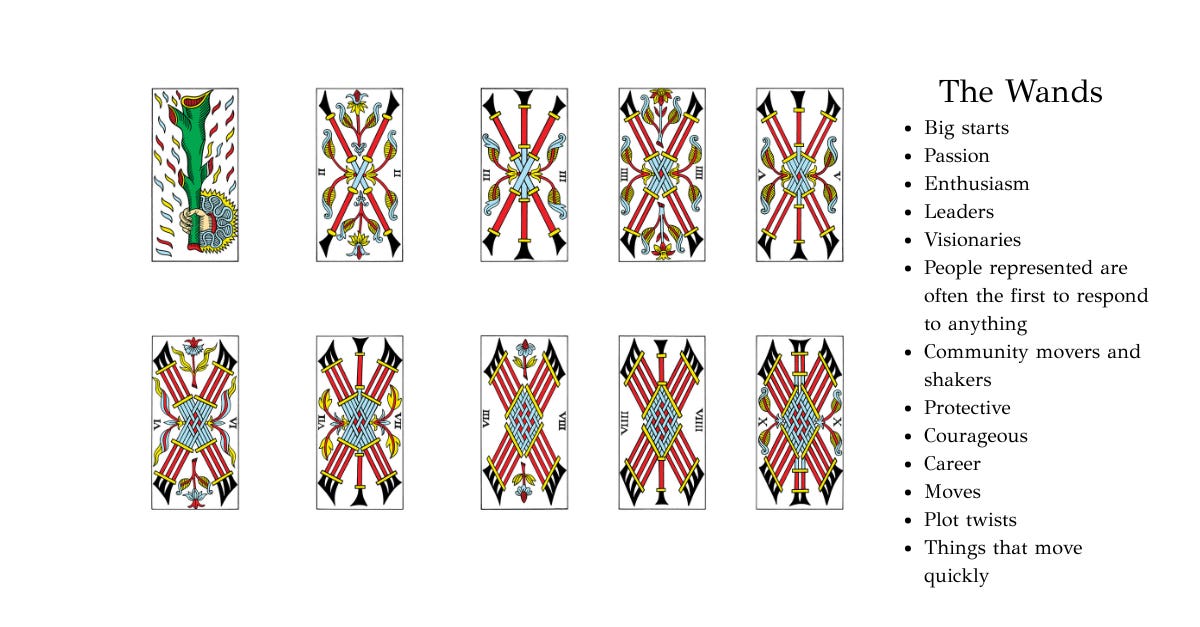
Look at that Ace! It’s a branch, cut straight from a tree. Its cut ends are all red like blood because this is fresh. It’s unhewn. The energy of the tree, the aura, is still present in this branch. The hand that holds it is emerging from what people have described as a cloud. Sorry not sorry, but when I look at it, I see uterine muscle. Maybe I’m just biased, but that is what I see: watery blue waves from the primordial ocean and muscle tissue. To me, that = womb. The auric sparks hover in the air. The muscle/womb/cloud that the hand is emerging from is trimmed with gold rickrack and reminds me of the crown tucked away behind the lemniscate atop the head of La Force, the second crossroads escort of the Major Arcana, but we can talk about that later (reminder to me to write about degree numerology and the TdM). The hand emerges from whatever you want to call that, which is to say, it comes from within. Keep that in the back of your head for later.
The Two of Wands is our first liminal Wands space; a crossroads. There are more of them along the way, but this is the first. Here the thing that was birthed and inspired with great passion and enthusiasm is held in a time that is not a time and a place that is not a place, to stabilize, consider itself, and grow. There are flowers and vines here, growing and unfurling. Things are balanced as direction and pace are considered.
The flowers disappear in the Three of Wands. The vines are still there, connected to the center, but they are more tightly curled and also facing outwards as if looking for somewhere to go. They are running out of room. Replacing the flower is a third wand being contained by the first two. The golden bands on the wands in the Two were soft and egg-shaped, but in the Three they harden into form with sharp edges. The third wand can no longer be held back; it is strong, straight, and taking up space.
In the Four of Wands, balance has been reached, but it is only temporary. The flowers have returned, and the leaves are facing inward again. The gold bands have fused, giving this the illusion of permanence. In the center of this crossroads is a blood red spot. The flower petals are red and gold now, with a full bloom at the top and a younger bloom at the bottom. They’ve had their stems cut, unlike their counterparts in the Two. Something is pushing at the balance that exists, so don’t expect the party to last.
In the Five of Wands, another wand has been introduced to break the stalemate and the first attempt at order found within the Four. The flowers are gone again, and the leaves are still turned inward. Disruption remains, but there is still room to grow. The four wands are still fused, and the fifth pushes from behind them. The top half of the fifth wand covers the fused gold bands of the four interlaced wands. The bottom half sits in between them; the wand is struggling. The center is still bright red; action continues there.
At the point of the Six of Wands, the crossroads is restored. The flowers have returned; their cut stems have healed. The top flower is older, with ragged petals and long ribboned leaves. The bottom flower is newer. The leaves on the sides are long and ribboned, older, and have produced small buds. The active center has increased by four. As before, the wands are carefully interlaced, and the gold bands have fused again to stabilize this space. It is stronger than the Four, but the blood red center has grown, so not only do we know that this state is temporary, but there won’t be any surprises from here on out because it’s not like we don’t see those little blood-red diamonds and understand their significance.
The crossroads of the Six is strong and durable, and what was achieved at that point will put up a fight to keep it. When the seventh wand emerges, the struggle is real. If you look closely at this wand, its pieces are crooked, as if it has become injured or misaligned. It is pushing out above the top gold bands of the six interwoven wands and still trapped under them at the bottom of this crossroads. The crookedness of this seventh wand is subtle, but once you see it, you can’t unsee it: whatever is emerging here is an upward battle, and victory comes at a price. The four blood-red spots in the center are still there, but now the emerging leaves are yellow and look like flames fed through red stems from the bloody center, where conflict keeps emerging. Even smaller leaves are emerging from this and will need attention.
At the point of Eight, the lattice is thoroughly woven and strong. The flowers have returned and this time they are the same, save for the direction of lines on their cones. One cone’s lines flow toward spirit, the other toward matter, like a dance between opposites. The energy is organized and flows with ease. There is more energy in the centre of this crossroads because it is no longer feeding outside sources (the leaves and vines). Order has been restored.
With the Nine of Wands, we have an interruption again. Something wants to come forth from the crossroads, but this time the wand is not fighting to break free. It is perfectly balanced, top and bottom, not struggling. There are no plants; all of the energy is spent, and unlike the other cards, we can not see this wand actually continuing through the center. It has merged, then stopped, and seems to have found peace, even if it has upset the balance.
As we reach the Ten, we may expect a balanced crossroads, since we have been primed to assume that based on the other even numbers. What we see instead is that the crossroads formed and perfected in the Eight of Wands still holds. Two wands now emerge, fused together, from behind the crossed eight. Plants once again grow on the outsides of this arrangement, as they did in the earlier odd-numbered cards. Tens are ones; 1+0=1, so the cycle has begun again. Sometimes this card reflects a beginning that hesitates to acknowledge or act on a new cycle (ten is a one with a purse!), and sometimes that zero bumps things up another notch, reflecting a transition period of upheaval.
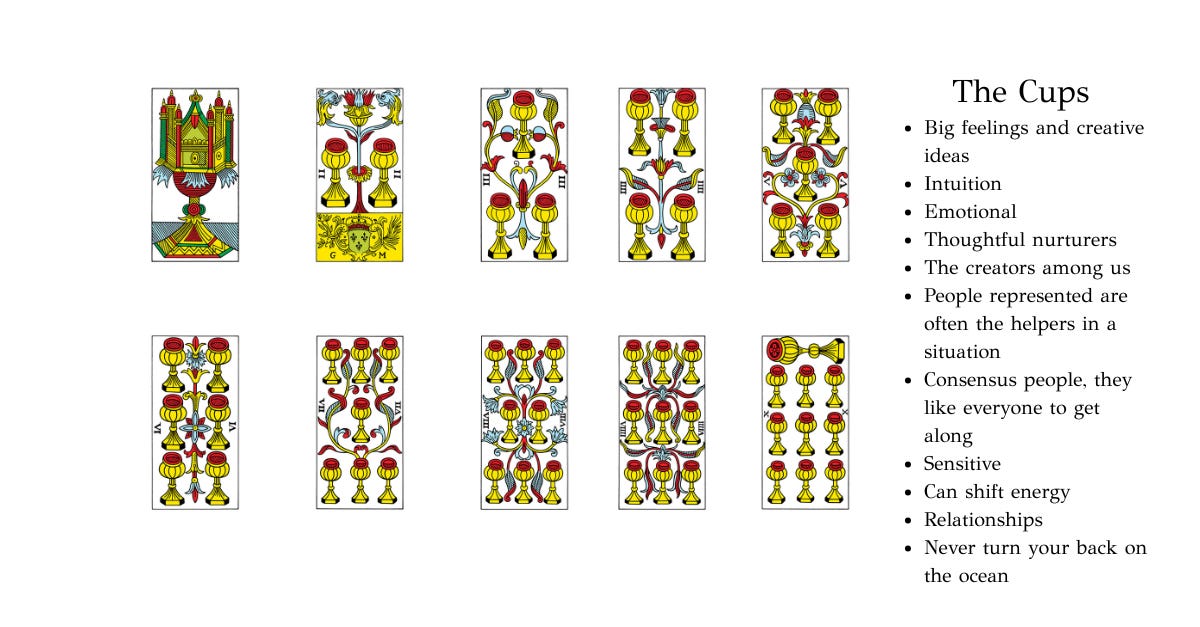
The Ace of Cups has confounded a lot of people over the years because they don’t understand what they’re looking at. The TdM is a medieval Tarot that reflects Christian mysticism. The item perched on top of the chalice in this card is a reliquary. To be frank, a reliquary holds a magickal item of great power. There are going to be Christians that take umbrage with this definition, but that’s what it is: a magickal strong box to both protect an item of magickal power from being damaged or destroyed and to protect people who don’t understand the item’s power from inadvertently or purposely doing harm to themselves or others. This elevates the Ace of Cups from a card that talks about romance to something greater. After all, look at the waves spilling forth from the spot where the reliquary covers the cup; what is trying to escape from that chalice/cauldron of creation? Something great is trying to emerge, and because it is water, it will simply push and build until that trickle becomes a roiling storm and you can no longer contain it.
The Two shows perfect balance. Here we see two fish leaping up alongside a central flower that emerges from solid earth. The flower is blooming and healthy, and has room to grow. Things feel safe and steady, held in place by the earth and the royal-type seal beneath the cups. The lines in the cups are different. One cup is spirit, and one cup is earth. They are both full, and quite possibly they are kindred spirits that “fill each other’s cups.”
From this union of opposites we get the Three of Cups. Something new has been born. The vines and leaves are curling around this third cup, directing their nourishment and energy toward it. The flowers are still buds, and the stems/vines emerge from a single pod that resembles a cup. Two tendrils above it curl to form a heart.
In the Four of Cups, we see a stable framework being established. Everything is perfectly balanced. The flowers all look healthy, and the leaves are spread out. Things are flourishing. The cups are still full at the point of the Four. They are all angled toward matter and physical concerns, which fits the nature of the Four. This creates a feeling of continuity and emotional stability, but also boredom. With a focus entirely on the spiritual and not what is in front of us, we all know that this stability won’t last.
With the Five, we see the element of something new added to what was a harmonious and well-ordered, if somewhat predictable, arrangement or relationship. In most decks, this is an unhappy event. Here, though, we see that the central cup is surrounded by flowers, vines, leaves, and flourishes that direct energy upward to the cup and then outward to be showered over the other cups. The cups are still full, and they are still focused on the spiritual or heavenly world (the direction of the lines in the liquid). Could this be the disruptive five that we see in the RWS and Thoth-based decks? It certainly could be, but that would have to be determined by the position in the spread, elemental dignity or reversal (if you read with either of those ideas in mind). For now though, this card shows the nurturing and feeding of a new element or new person, and the ability to accept someone or something new into the established order.
Balance, order, and harmony have been reestablished in the Six. There is a repeating pattern of three pairs of two cups each. They are organized around a singular axis of flourishing leaves and flowers with a full bloom in the centre. This flower and the one below it both have astrological Sun glyphs, indicating some indirect solar involvement. There is warmth, happiness, and with three pairs of two, the suggestion of community or family, or at the very least, others. The focus is more on continuity and community than it is on the individual.
An additional cup has appeared, and this time it would seem that resources are stretched a bit thin. The cups are still spirit-focused, but now they are half full. The central cup is sequestered away from the others by leaves and vines, but there are no flowers. The bottom leaves point towards the single cup, but the rest all direct energy away, funnelling it to what appears to be a double guard of two groups of three cups each. They could symbolize a community of like minds sizing up a new addition or opportunity. They could also be two groups taking sides and arguing about bringing this new thing into their periphery. The central cup in the top row is almost but not quite sequestered from the central cup. This could symbolize a turn in the tide regarding something, an opportunity presenting itself after a stalemate, or perhaps a peace offering during a standoff.
As we reach the Eight of Cups, two cups are in the centre, separated from each other but both encircled and protected by the vines and flowers. They have a fully open blossom between them that could be the Sun glyph or perhaps an all-seeing eye with a message. The central cups of both the top and bottom rows are also encircled with leaves. This could be a 6+2 situation or perhaps a 4+4. It is a flexible situation that can be judged a few ways. Two might be joining the community of six joyfully with eyes open, or four could be sequestered/protected while the four outside cups stand like watchtowers. There is harmony here, though, and the cups have regained their fullness, along with integration, perhaps because decisions were made.
Nines are about fulfillment, and here we see the complex dynamics of 3 x 3. Not only is this a well-ordered community, but we still have watchtowers. Something has been created, welcomed, and nurtured, and whatever it is, we do not want to let go of it. The three central cups form a column where each one is protected by the vines and leaves that direct energy outward to the remaining cups. As a matter of fact, each cup has its own compartment, separate but together, all drawing energy. The lines in the liquid still show that the energy is being directed towards spirit, creation, love, or other such higher endeavours, but once again the cups are half full. While the image is overall harmonious, maintaining this level of fulfillment takes work!
Here we are at the Ten, the end of the line. There are no flowers, leaves, or vines to direct energy or feed the cups. They are half full and won’t be replenished. They are organized into a 3 x 3 formation, still expressing collective unity and community spirit, three manifestation triads working together, but a tenth large cup is lying on its side over them. This cup has a lid, resembling the emblem on the coins. Quite possibly this cup will pour earthly delights and energy upon these cups, who have been doing only the higher work of spirit since the Three of Cups. They need grounding, and possibly, if the size of this cup is an indication, a specific leader or directive in order to allow the new cycle to truly begin.
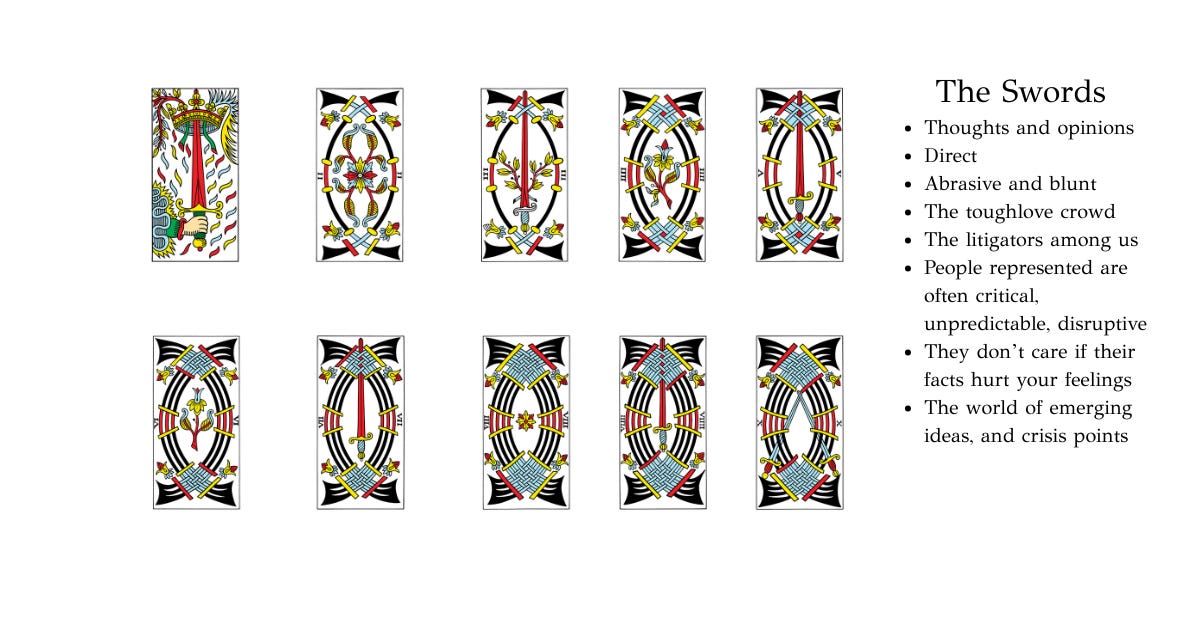
Here we see the mysterious wavy blue mass in the second of the “hard suits” (Wands and Swords). This time, though, the hand is not coming from the centre of the mass. It is on the outside edge. The energy of the Wands came from within, but the energy of the Swords is external. This can be in the form of a situation that happens to you or perhaps an idea that disrupts your ordered world. The same sparks of energy are here in this card that are in the Ace of Wands. The sword is red, the colour of passion, and it pierces the crown of gold. The inside of this crown is blue and light sienna, which can symbolize being informed by the opposing forces of spirit and matter since they would be in contact with the head of whoever wears the crown. The two plants are laurel and palm. One has an open end, and the other is closed, indicating an open circuit, meaning, actually, that energy is disrupted - it can not flow properly. They both have cut bottoms that are red/bloody, so the disrupted energy is fresh. They are both plants associated with victory and sacrifice. Unlike the hand that holds the wand, this hand faces away from us so we can not see if it conceals anything else.
In the Two of Swords, we see our first vesica piscis, the fish shape formed when two monads/circles/universes intersect. This shape is a portal of emergence. The gold bands around the two swords are round like eggs. This portal is new and not really strong. Each sword contains opposing colours that sit in balance, though. The flowers outside the barrier formed by the portal are new and have not yet bloomed. Inside the vesica piscis, there is a large flower in full bloom with a Sun glyph at its centre. The leaves are curled towards it, and it appears to float in the centre with some room to grow, but not much. It will need to leave this safe space sooner rather than later. For now, it can rest and take advantage of the protection offered by this portal and emerge fully on its own time.
At the point of the Three of Swords, we have a breakthrough victory. Perfectly balanced and upright, gilded in the red blood of passion, the sword thrusts through the barricade created by the two worlds overlapping and starts to force its way out. The barricade is still weak; the gold trim is still soft and egg-like. Three of the external buds are red, and one is white, so the balance of energy in the world beyond the portal is shifting. The two swords forming the portal have also switched sides. Instead of a flower, the sword is decorated with two laurel branches, the symbol of victory given to competitors. This is a victory and breakthrough, but it has not been difficult because the portal is still new. Our seeker needs to consider what things in the outside world might be like, though, given that the flowers are starting to change.
The flower returns in the Four of Swords, but the portal of emergence is starting to become more of a barricade than a birthing canal. The outside flowers are all the same and look healthy, so things are at peace away from the vesica piscis. The gold egg shapes have hardened, and the swords have switched sides again. The walls are thicker, and both ends now have spots of blood in the lattice, indicating that what appears to be stable and peaceful won’t be for long. The flower inside has not fully bloomed and looks young and healthy but has little room to grow. The leaves can’t open, and while things may be safe right now, eventually that flower will wither if it doesn’t leave its “safe space”. This shows a limited situation or perhaps trying to grow or work against all odds.
With the Five of Swords we have another breakthrough, this time through a challenge or other disruption that provokes us to act. The barrier has not grown, but the swords have changed sides. This is continual through almost the whole suit. It is still balanced, but it is too big for its enclosure and does not appear to be fighting its way out. This is the largest sword of all the swords after the Ace. Its blade is red with blood and passion as it pushes with steady force. The flowers in the external world are balanced; it is the internal world where the issue exists. Things are literally tight, and something needs to give. As this is the largest sword, we could see this cutting as the imposition of one’s will upon what is a balanced situation and stirring the pot.
The flower returns with a smaller red cone than before in the Six of Swords. The little branching leaves and bud have been replaced by a single small bud branching off the side. It is small, hard, and black. The flower has accepted its limitations in this “safe space,” and as the walls get thicker, it shrinks accordingly. There are no more patches of red blood in the weave of the swords. One could say that perhaps passion has left the chat and that the ambitions and competitiveness in the earlier cards have been put aside so as not to disturb the present balance.
In the Seven of Swords, much like in the Seven of Wands, we have one against six. This sword is smaller than its predecessor; sleeker and sharper. With a handle made of blue, the colour of spirit, whose lines also move toward spirit and higher thinking, the sword pushes through the now larger barricade. There are two red spaces in this lattice. You might confuse them for the sword itself but they don’t carry the line in the blade. The sword is coming out from under the barricade, not trying to weave through it. There is one subtle difference in the external flowers, so things are changing in the world around the portal/barricade. The single sword does not change colour. It stays red, so it is with its own concentrated will (and a little bit of creative thinking choosing to conceal its exit by sliding under the red) that it creates its own victory.
The barrier has grown considerably, and the space within is very small. The flower has shrunk down to a small and symmetrical square. It has the Sun glyph centre. It’s colours blend in with the centres of the swords, as if it is trying desperately to shrink itself and fit in. The flower may be safe, but it has to rationalize its choices to stay there. It is isolated from the flowers in the external world and will have to continue to shrink itself in order to fit an environment which keeps shrinking. Being ultra protected also means being isolated and blocked.
At the point of the Nine of Swords, the barricade has not grown. The sword is small and is still trying to push its way out underneath the lattice. We could see the red spots that don’t carry blade marks as possibly being blood that is pushed to the surface, either from the barrier suffering blows or from the sword becoming injured. In spite of the thick barricade, this sword keeps on pushing, but if you look closely, the sword is disjointed. It looks like it has been broken and put back together. Courage and determination keep it moving ever forward to win what might feel like an unwinnable battle against more evolved or better-armed adversaries. It pushes forward by working with what it knows and has.
At the point of the Ten, we expect flowers because this is an even number, but there is no flower in the barricade. It is gone. The swords in the barricade have stopped switching sides. Everyone and everything in this fight is exhausted or gone. There are only two flowers left in the external world beyond the barricade. The flowers inside have been replaced by two swords. This time the handles are the red of passion, and the blades are the colour of spirit and righteousness or higher intelligence. They are unbalanced and caught up in the strong weave of the prison they try to escape. Although they are struggling, the colour of their blades is indicative of taking a more sophisticated approach to finally putting something to rest. That there are two can also indicate asking for help, although at this stage, they may be a day late and a dollar short.
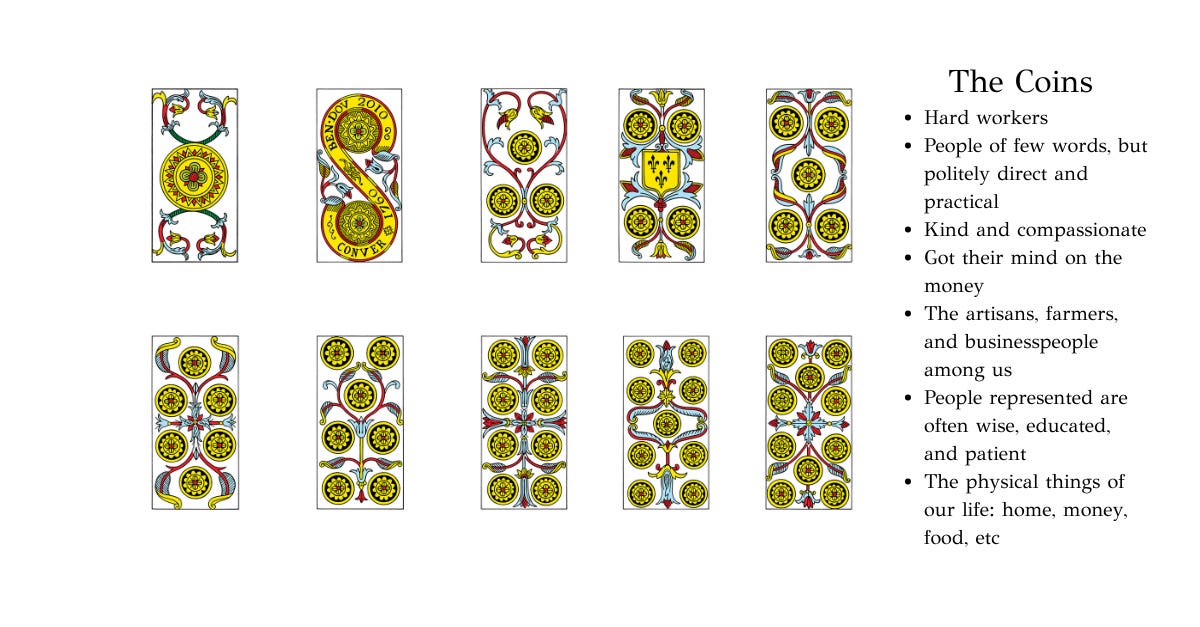
The Ace of Coins is the only ace we behold by looking straight down at it. It is a two-dimensional image of a coin. The other three aces are upright. This reflects a more basic and grounded nature in this suit. The coin represents the ground from which all of the other suits grow. While they all show intangibles, the Ace of Coins is very much of the material world. Without a body, there is no home for passion, creation, or intellect. It has been theorized that the four petals in the centre symbolize the structure of the Tarot suits, with the circle in the middle symbolizing the Major Arcana. It also symbolizes the monad, the contained universe of potential from which all things emerge. It contains within it the potential for all the other suits. Within this ace are solid starts, physical stability, and a practical “ground up” perspective.
In the Two of Coins, we see an apparent balance, but at the same time the ribbon gives a sense of movement. There are options here, side by side, but as is always the case with the two vibration, if anything is happening between these two coins, we aren’t privy to it. They undulate with the ribbon, separately but yet together. We can see safe options or safe choices in this card as well as growing or nurturing something perhaps at a bit of a distance. Becuase the coins/monads are not joined, they have not yet produced the vesica piscis that will allow for the emergence of the three. Things are happening…..slowly.
The solid base formed by the two coins eventually gives way to the Three as the ribbon, which contained leaves and flowers on both ends, transforms fully into what looks like a circulatory system nourishing and supporting new life. They enclose the third coin, directing energy into it. This is a productive, if not modest, turn of events. Any tension in the situation being read will probably be eased if the seeker quietly tends to the little things showing up for them.
In the Four of Coins, we see four coins surrounding a shield. Vines and leaves come out from this shield and direct energy around the coins. They are like watchtowers, protecting this object and also being supported by it simultaneously. This shield is actually the coat of arms of the Kingdom of France and Navarre. It shows absolute power and divine sovereignty at the centre of this card. Practically, it was also a place for cardmakers to put a stamp showing that tax or duty had been paid. Esoterically, it is the ultimate axis of stability. It can also show the sort of balance and continuity by doing things in very specific, time-tested ways, as well as notions of honour or loyalty.
Everything was great until the five vibration showed up to throw a wrench in the works. It disrupts the stability of the four. The shield is gone; divine authority and tradition have been done away with. Instead, we have a singular coin surrounded by four outside coins. The leaves and vines surround it but do not direct energy. This is not the happy welcoming of the Five of Cups (and yes, I know in RWS decks this is not a happy card, either). There is little tolerance or acceptance here. The leaves that point toward the centre coin are pointed and spiky, reminiscent of the leaves in the Seven of Wands, but coloured the blue of righteousness. The leaves around it look almost like profiles of people looking away. Within this card is reactionary “low vibe” behaviour and a desire to isolate someone or something. Clearly the coins aren’t thrilled with things that disrupt the order.
Harmony returns in the Six of Coins - or does it? The central flower is a bit small and tight, directing energy to all the coins through its leaves and vines. Two coins are sequestered away from a central square of four coins. Order is occurring, like the townsfolk reassembling and coming together. Seen from another point of view, these are two triangles, one up and one down, with each coin being nourished in its own cell. This doesn’t have the disruptive, hostile feel of the Five. This feels integrative, as though everyone is trying to get to know each other. Things are settling down, people are being good to each other, and everyone is being fed.
This is a more peaceful Seven than the last one we saw. The four stable coins are at the bottom of the card, with a descending triangle integrating. The circulatory system of plants found in the Coins and Cups is nourishing and protecting everyone. Once again, each coin has its own cell to exist in, yet is still connected to its neighbour. One coin is encircled completely, and the largest flower feeds/protects it. It is possible that this points to a healing or convalescence, or a community project to help an individual (like turning out to help someone rebuild their home after a storm). Whatever is going on, it does not feel hostile or unbalanced even though this is an odd number.
At the point of the Eight of Coins, we see uniformity and order. Each coin is still in its own cell, its own private space, yet all are joined by one central flower that produces four other blossoms as well as four leaves. All is symmetrical, all is predictable. We have the stability of the four without the blind obedience to a commanding power - it looks like power to the people here: everyone on the same page, no one better or worse off than anyone else. Within this layout are patient routines, consistent efforts, and a lot of hard work to keep everyone in the same state - but at the same time, the flowers are healthy, so this is not draining work. It is aligned effort; this is what should be happening.
Looking forward to the future, the Nine of Coins plants a seed right in the centre of the card. Flanked by beautiful flourishing leaves and (mostly) symmetrical blossoms on either end, this coin is watched closely as it grows. It can also be seen to be isolated and pressured by the flank of two squares of seemingly immobile coins. Often when I look at this card I see the sort of positive “motivation” (pressure) placed on one person within a family - “your parents were the first to graduate high school so you will be the first to go to university” - that kind of pressure. Not bad, but there is an expectation of results when you look at the energy and protection being channelled into this one coin. Perseverance and “good stress” can bring great yields and success.
Here we are at the end! Two fives bring everything into full realization via challenges and new ways. The central flower is large and branches outward, actually going underneath two of the coins instead of around them all. Looked at another way, two manifestation triangles flank the ever-present “four square” of solidity and stability. There is an abundance of energy and resources in this card; everything is flourishing. It’s stable, but there is the possibility for more. This is comfortable and let’s face it - hard to leave, but we will eventually have to find a new challenge because this is a ten, after all, meaning that the new cycle has already begun whether we can see it or not. We can use this bounty to invest in the next great thing.