

What I did this week in the Codex
This is fast becoming "How I spent my summer vacation"

Cross-posted from my Patreon: thenumerologylady.com
There are weeks when progress looks dramatic from the outside, and there are weeks when progress looks like rearranging labels, fixing tiny glitches, and cursing at a screen because one mysterious little 0 keeps attaching itself to people’s names.
This was one of those weeks. I should have been more chatty about it, but I tend to put my head down and work, work, work. Then, when I’m done, I think “No one is interested in hearing about this”, and mosey off to do something else.
But you know what? This was also the week that this began to feel like a real working system.
For anyone new here, Codex Numerorum is the numerology app I’ve been building as a private charting and interpretation tool. It began because I needed something more flexible than a calculator, more serious than a novelty generator, and more aligned with the way I actually read charts. I wanted a place where Vedic-style ank jyotish, Chaldean, and Pythagorean numerological timing, name analysis, compound numbers, Tarot, and my own interpretation library could live together, and I could put all my notebooks into a burn box for the August long weekend bonfire. That’s the projected end date. I want to be able to take all my reference notes and burn them. That burn box is HEAVY.
This week, I spent a lot of time doing the kind of development work that sounds small until you realize it changes how the system can be used.
One of the biggest changes was the addition of a Tarot library inside the Aula Numerorum. The Aula is the interpretation library inside Codex, and until now, it has been focused strictly on the numbers 1-99, which is a task in and of itself. It changed up how things display and added space under each number for natal placements, transits, mitigation, and how the numbers behave in affliction.
Then I added space within the Aula for Tarot cards numbered 1 through 78, with fields for general, positive, and negative interpretations. Then I expanded the structure further so each card can also hold interpretations by area of inquiry: people, relationships, spirituality, work, money, technology, health, and shadow.
I also spent the better part of this afternoon uploading all of the Tarot card images and gave the cards titles in both French and English. That makes me very happy. It gives the system more of the old-world feeling I want it to have, while still keeping it usable, modern, and clear.
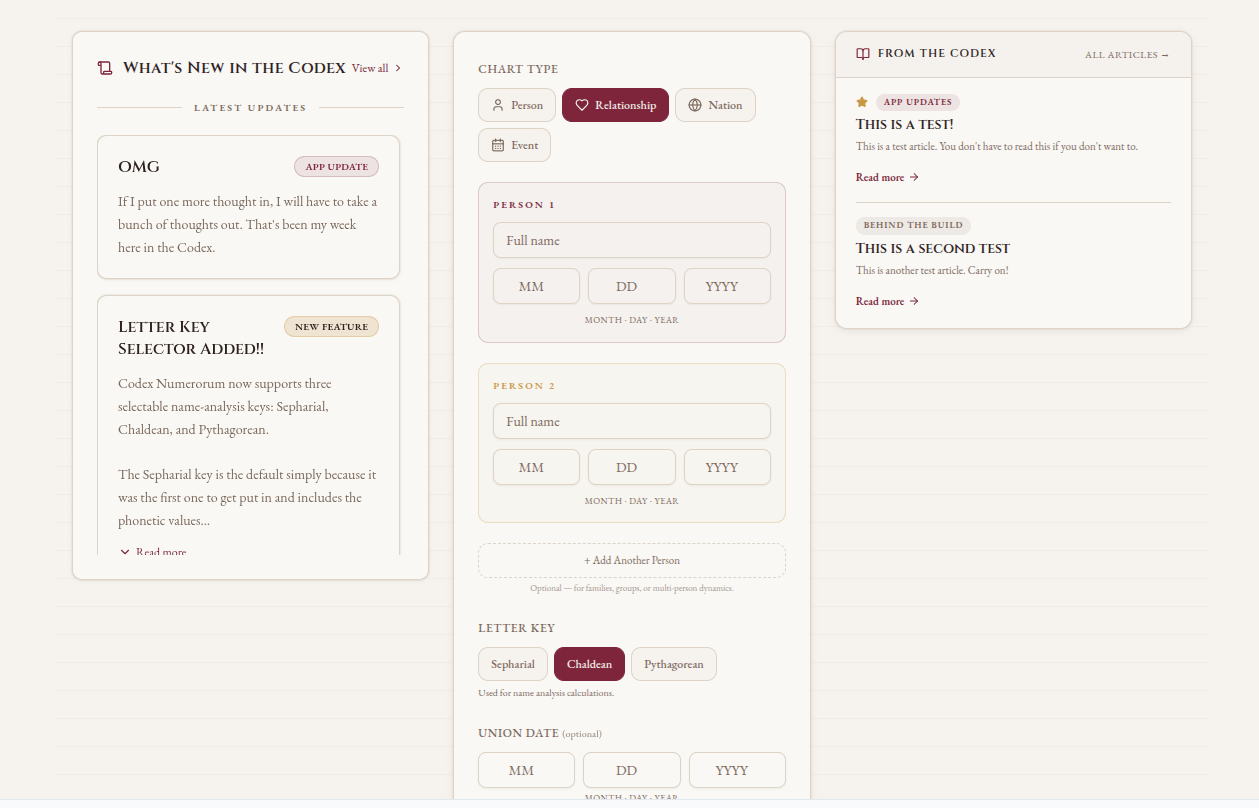
Another major update was the continued refinement of name analysis. I don’t want people to feel like their numerology isn’t represented. Like I’ve said before, I am over the whole “Mine is the one and true” nonsense. Codex now allows different alphabet keys. Starting out, I’ve put in Sepharial, Chaldean, and Pythagorean. This matters because numerology is not as monolithic as people often assume. Different schools of thought use different letter values, and now that I’m reaching into my brain and pulling all of this stuff out, more is flooding out of the memory banks and the more interested I become in preserving those differences found in obscure books from 100 years ago instead of pretending there is only one “correct” key.
This also means the app can better support comparison and research. A name can be viewed through more than one lens. That is much closer to how I actually study numerology.
I also continued cleaning up the chart interface. Some of this was pure “dusting the shelves” work: changing labels, making the display clearer, hiding long interpretations behind collapsible buttons, and making sure the language feels like my system rather than borrowed language from somewhere else. For example, I changed certain timing language from “rhythm” to “pattern” because words matter, especially in a field where everyone is building on, reacting to, or trying not to accidentally copy everyone else.
One of my favourite updates this week was the continued development of Western timing inside the app. Codex began with a strong Ank jyotish foundation, but I also use Western numerological timing, including personal years, personal months, personal days, triads, and major planetary cycles. The app now does a much better job displaying those Western timing patterns clearly, including compound and reduced numbers where appropriate.
That is important because compound numbers are a big part of how I read. A 46/1 is not the same as a 10/1 or a 19/1. They all reduce to 1, but they do not arrive there by the same road.
The biggest surprise feature of the week, though, was Relationship charts.
Originally, the app had a “Couple” chart option. That was fine, but it felt too narrow. Not every relationship chart is a romantic couple. People may want to look at spouses, business partners, creative collaborators, families, households, chosen family, or polycules. So the chart type is now called Relationship, and it no longer assumes there are only two people involved.
The Relationship chart now has fields for Person 1 and Person 2 by default, and it can also add additional people. That means Codex can now create charts for groups of three or more people.
More importantly, it worked. The app can now cast, save, archive, and reopen multi-person Relationship charts. It can also remove an added person before casting and correctly return to a two-person chart. There was one really hilarious bug that dogged me this week, involving a stray 0 that kept attaching itself to participant names, but that fun little mother effer has now been banished.
I am especially excited about this feature because it moves Codex away from the usual “compatibility calculator” model. I am not interested in reducing relationship work to “Are we soulmates, yes or no?” Real relationships are more complex than that. Families are complex. Creative partnerships are complex. Households are complex. Polycules are complex. Even a two-person relationship contains more than one storyline. A metaphysical tool should be able to hold that complexity.
Right now, this is my favourite part of what I’ve done, especially after being treated to a fellow numerologist rant on their IG about single mothers and “the gays” -- people like me -- are responsible for everything that is wrong in the world. It won’t fix that individual’s opinion, but it is my small way of letting people know that I see them.
This week also reminded me why I made the app private while I build it. Every time I add something, I find three more things that need to be cleaned up, tested, or renamed. That is not a bad thing. It means the system is growing and becoming more itself. It is being shaped by actual use, not by an imaginary perfect launch day. Every Saturday, I go to The Alchemist to see clients and cast their charts, and I leave there at 5 pm with a list of things I can do better. I am extremely happy about that, just so you know.
At this stage, Codex Numerorum is still very much in development, but it is no longer just an idea. It casts charts. It stores interpretations. It handles multiple systems. It holds Tarot images. It supports different alphabet keys. It is beginning to reflect the way I actually work as a numerologist.
And this week, it learned how to hold more than two people in a relationship chart.
That feels like such a big deal. Next week I want to make that section pretty, but for now, I’m just happy that it’s there.
Thank you for being here while I build this in real time. Patreon is a huge part of why I am able to do this at all. Every post, every test chart, every little update is part of the larger process of building a tool that I hope will eventually support the growth and development of myself, other numerologists, and maybe even contribute to the body of work within the field.
Now I need to go stare at something that doesn’t need a debugging protocol and have some tea.
Over and out 💗